
The Legal Studies program at College of DuPage (formerly Paralegal Studies) provides students with the knowledge, training, skills, values and attitude they need to become highly competent, ethical paralegals who will make a positive contribution to the advancement of the paralegal profession.

Students will gain knowledge and skills through Legal Studies courses in a broad range of topics including criminal law and procedure, ethics, law office organizations and technology, legal research and writing and litigation. A required practicum will provide you with crucial hands-on practical experience in the legal field so you feel prepared to enter a career in working in a law firm, corporate law department, government agency or business organization.
Per the American Bar Association, all Legal Studies students must take at least nine semester credits, or the equivalent, of legal specialty course through synchronous instruction. This requirement can be satisfied through a live, virtual class (VCM) or a traditional in-person class.
Application Process
Prerequisite coursework which includes Legal Studies classes LGLST 1100 and LGLST 1150 and a Legal Studies program application must be completed before official admission into the degree and certificate programs.
First semester Legal Studies classes include LGLST 1100, LGLST 1150, LGLST 1200, OFTI 1200. ENGLI 1101 or equivalent also needs to be completed before earning an Associate in Applied Science degree.
Determine Your Path
Paralegals work under the supervision of an attorney and help provide high quality, cost-effective legal services to the public or private sector. Paralegal professionals find themselves conducting client and witness interviews, engaging in investigations and research, drafting legal documents and general correspondence, assisting in trial preparation and preparing documents for real estate, probate and corporate matters
Although paralegals cannot provide legal services directly to the public, except as permitted by law, they are becoming an indispensable part of the legal team.
Whether you are preparing for a career as a paralegal, planning to transfer to a four-year college or university or updating your skills, College of DuPage has the right program for you. We offer:
- A Legal Studies program that is approved by the American Bar Association (ABA).
- Dedicated instructors with years of professional experience, certification and licensing.
- Flexible schedules with day, evening and online learning.
- Practical, hands-on experience as well as classroom-based studies.
- Affordable programs that get you on the fast track to success without breaking the bank.
- Articulated transfer agreements that provide students an affordable educational option with seamless transfers to prestigious universities.
- A law library and a subscription to Westlaw, the premier legal research database.
- An Advisory Council made up of industry professionals that ensures the Legal Studies program stays current with the ever-evolving business of law.
- Opportunities for current paralegal students to develop long-lasting friendships at the Paralegal Club and alumni gatherings.
Visit the Paralegal blog to learn more about networking events, job opportunities and more.
Legal Studies
The Legal Studies, Associate in Applied Science degree program prepares students for careers in a variety of legal areas including litigation, corporate, real estate and insurance.
Curriculum covers law office organization and technology, legal document drafting, litigation, legal ethics, and legal research and writing, as well as a variety of specialized areas of practice such as corporate and contract law, criminal law, environmental law and immigration law. In addition to classroom requirements, a practicum provides students with real-world experience.
The Legal Studies Associate in Applied Studies degree is for students who do not have a college degree and are seeking a two-year college degree in Legal Studies.
Legal Studies
The Paralegal certificate is available to students who have earned an associate’s degree (Associate in Arts or Associate in Science) or higher.
The certificate prepares students for work in a variety of legal areas, including litigation, corporate, real estate and insurance.
Curriculum covers business law, civil litigation, law office organization, legal document drafting, legal ethics, legal research and writing, and MS Office for professionals.
The certificate program is for those who already have an associate degree or a four-year degree from a regionally accredited college/university and are seeking to add the certificate credential to their degree.
Students who are planning to enroll in the Legal Studies program at College of DuPage may be qualified to receive a financial award through a variety of supported scholarships.
- The Honorable William J. Bauer Scholarship for Paralegal and Criminal Criminal and Justice Studies
- Sally N. Fairbank Paralegal Studies Textbook Scholarship
- Capper and Marilou Grant Paralegal Scholarship
- Linda and Robert Jenkins Endowed Paralegal Studies Scholarship
- Lori & Eric Swanson Paralegal Scholarship
Visit cod.edu/scholarships for requirements and a full list of available scholarships
COD Stories
"Whenever I had an idea or goal, the answer I received was never that my idea or goal wasn’t going to happen, but instead how can it happen." - Meggie Hernandez-Zayas
Meggie's COD StoryCOD Stories

“Without completing the Paralegal Studies program at COD, I would not have been comfortable interpreting hearings, depositions, arbitrations and other legal proceedings. I am very happy I completed the program and received all the knowledge needed to call myself a professional legal interpreter." - Olga Bronovytska
Olga's COD StoryCOD Stories
“Take that first step toward your educational and career goals. The COD Paralegal Studies program's American Bar Association-approved status gives you the opportunity to earn a degree or post-degree certificate that is recognized for meeting high standards in legal education.” - Zac Wiles
Zac's COD StoryCOD Stories
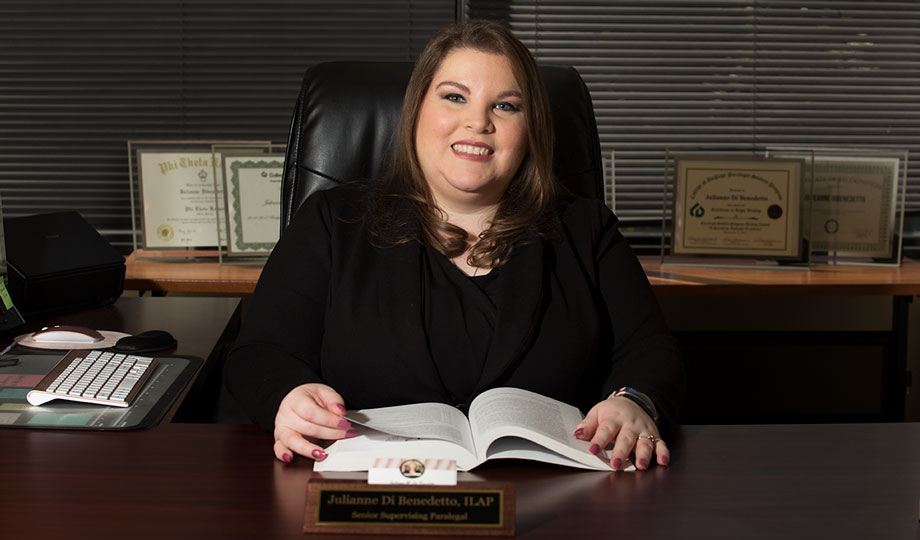
“The experience that I had was life-changing. Through this program, I found an amazing career and made lifelong friends." - Julianne Di Benedetto
Julianne's COD StoryCOD Stories

“COD helped me improve my skills in everything, whether I was taking a general math class or my litigation class. I was blessed to have teachers who are not your regular teachers. They are lawyers or judges who, most importantly, are passionate about their careers, and that made the world of difference to me." - Brenda Medina
Brenda's COD StoryGet Started Today
The first step to getting started in Legal Studies is to apply for admission.
Legal Studies Information Session
Information sessions are held periodically throughout the year to introduce prospective students to the Legal Studies program. Learn More
Academic and Career Pathways give you a roadmap to achieving your career goals. Follow a pathway based on your degree that outlines which classes you need to take and when so you graduate on time or move on to the next phase in your career.
The Legal Studies program is designed to provide students with the knowledge, skills, values and attitudes they need to become highly competent, ethical paralegals working in the delivery of legal services, and who will make a positive contribution to the advancement of the paralegal profession. The program’s learning objectives, listed below, indicate the knowledge, skills, and abilities that students will have acquired upon completion of the program.
Legal Studies graduates will:
- Explain the role of the paralegal in the effective delivery of legal services in various settings in which paralegals work, including large and small law firms, corporations and businesses, governmental agencies, and legal aid offices.
- Describe the ethical responsibilities of paralegals, the rules of professional conduct governing lawyers, and the application of these rules to paralegals.
- Apply practical methods to complete assigned legal tasks.
- Demonstrate competency in a legal setting by completing a paralegal practicum under the supervision of a practicing attorney and a faculty member.
- Analyze, implement, and complete a legal research project using both print and electronic resources.
- Produce legal documents that meet professional standards, reflect accurate legal research, and are in correct format.
- Demonstrate proficiency in use of technology applications common in the workplace.
College of DuPage has several paralegal studies transfer agreements in place with four-year colleges and universities to save you time, money and make the transfer process easier.
Many of these agreements with other colleges and universities have specific course requirements and a pre-determined course plan that needs to be followed to be eligible to transfer. Contact a program faculty member or academic advisor to learn more as course requirements vary by institution.
Legal Studies Program

The Legal Studies program at College of DuPage provides students with the knowledge, training, skills, values, and attitude they need to become highly competent, ethical paralegals who will make a positive contribution to the advancement of the paralegal profession.
Career Information
Explore careers based on your interest, location and salary range or view top occupations by income.
The Career Ready Podcast
Careers as a Paralegal with Annie Knight
In today’s episode Michelle interviews Assistant Professor Annie Knight, Program Chair for the Legal Studies Program at College of DuPage. Throughout the interview she discusses the career possibilities in Paralegal careers along with skills needed to succeed in the profession. Tips to get started are also shared in addition to specific details about studying the program at College of DuPage. Learn More
Follow the Legal Studies Program on Facebook
See what current paralegal students are doing in the program by following Legal Studies on social media.
 Facebook: @codparalegal
Frequently Asked Questions
Find answers to your frequently asked questions regarding the Paralegal Studies program.
A paralegal is an individual who is educated and trained to perform legal tasks delegated and supervised by an attorney.
While specific paralegal duties vary depending on the work setting, paralegals frequently conduct client and witness interviews, engage in investigations and legal research, draft legal documents and general correspondence, assist in trial preparation and during a trial, and prepare documents for real estate, probate, and corporate matters. All paralegal duties are conducted under the supervision of an attorney.
Paralegals experience high job satisfaction since they are frequently given a great deal of responsibility and independence in performing their work,although their work is reviewed by the supervising attorney. In addition, many paralegals meet the public on a regular basis.
Paralegal jobs can offer much variety as well as intellectual challenges, and paralegals experience the rewards of serving a client's needs as part of a legal team.
Successful paralegals are highly organized and detail-oriented. They enjoy problem-solving and can work well independently. They have excellent communication skills, and particularly, superior writing skills. They are accomplished in the use of technology. They are good at listening and following directions. They work well with the public and understand the necessity of maintaining client confidentiality. They act and dress professionally.
Some employers suggest that paralegals should have a "thick skin" because attorneys can be short-tempered and abrupt when business needs are pressing.
Job requirements vary widely. Some require a post-degree paralegal certificate in addition to a four-year college degree, others may accept a two-year associate degree, and still others may not require any formal paralegal education as long as the individual has law office experience or is willing to be trained on the job.
Frequently employers seek a paralegal with a combination of formal paralegal coursework at a college or university plus paralegal experience in a law office. Strong communication and analytical abilities, plus skill in using technology applications that are common in law offices (Microsoft Word, Excel, Outlook and legal research technology such as Westlaw) are usually preferred and may be required.
The length of the program varies depending upon the program in which you are enrolled. College of DuPage has two program tracks, one for students seeking a college degree and another for students who already have either a two-year or four-year degree and are seeking a post-degree certificate.
Students without previous college credit who attend school full-time (15 to 18 credit hours per semester) can obtain an Associate in Applied Science degree in Legal Studies in two years. Students with a college degree who attend school full time (12 to 15 credit hours per semester) can obtain a Legal Studies Certificate in one year.
Courses are rigorous and demanding and it may be in the student's best interests to take less than a full load each semester. There is no required time period within which to complete the program.
The required Legal Studies Practicum, PLGL 2600, is an excellent way to obtain job experience.
Student perform 120 hours of paralegal work during the semester (approximately eight hours per week during the fall and spring semesters), working in a law office under the supervision of an attorney.
Required seminars on campus provide the students with information about resume writing, interviewing skills, creating a professional portfolio, and creating a personal website for posting an electronic portfolio. The program culminates in a "Portfolio Expo" in which area attorneys, practicing paralegals, and other career professionals review and critique the students' portfolios, ask mock interview questions, and provide constructive information about obtaining employment as a paralegal.
Students are eligible to enroll in the practicum after they have been admitted into the program and taken PLGL 1200 - Civil Litigation, PLGL 1500 - Introduction to Legal Research and Writing, and PLGL 1250 - Legal Ethics and Law Office Organizations. Instructor consent to enroll in the practicum is also required. There is a separate application that must be completed approximately ten weeks before the beginning of the semester in which the student seeks to enroll in the class.
Students are expected to locate a practicum site on their own by undertaking a self-directed search, which gives them valuable job-search skills. The Coordinator provides a letter of introduction for the students to use as they search for their internship, as well as a list of prospective internship sites and a variety of resources for obtaining an internship. Before receiving the instructor's consent to enroll in the practicum, students must demonstrate that they have obtained a practicum site, or have made significant efforts to obtain one. Students who have difficulty obtaining a practicum site can seek suggestions from the Program Coordinator. Students currently working in a law office may use their existing job to fulfill the work requirement for the practicum, as long as their supervisor is an attorney who agrees to serve as their site mentor and assign them paralegal work that is outside the scope of their ordinary duties.
The Associate in Applied Science degree program is either 67 credit hours or 70 credit hours, depending on which math class you take.
If you take Math 1100, you will also need to take Psychology 1100 or Sociology 1100, which brings the degree program up to 70 credit hours. If you take Math 1218, you do not need to take the additional psychology or sociology class. Therefore, the degree program will cost either $9,380 for 67 credit hours or $9,800 for 70 credit hours.
If you already have a college degree, you will be in the certificate program, which is 36 credit hours. At the current tuition rate, the certificate program will cost $5,040.


